
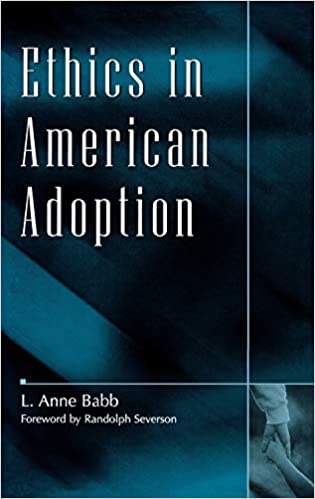
Ethics in American Adoption
Ethics in American Adoption examines the values underlying adoption practice and addresses the problem of unethical behavior in adoption service delivery. Seminal in the fields of ethics and adoption, this book describes what is wrong with America’s adoption system, illustrates what the lack of applied ethical standards does to adopted persons and those who love them, and raises questions about whose interests adoption facilitators serve.
“One of the best books I have read on adoption.” — D. DeLorenzo, Adoptive Parent

Adopting and Advocating for the Special Needs Child
This book bridges the gap between the desire to help a waiting child and the realities of navigating America’s special needs adoption system, covering key topics such as getting started, becoming a family, facing realities, and coping when things go wrong.
“Completely frank and remarkably compassionate, this detailed, comprehensive guide […] is an important, sorely needed addition to the current informational literature on adoption.” — Booklist
“A wealth of practical advice [ . . . ] A nice addition to any adoption collection.” — Library Journal

Clinical and Practice Issues in Adoption
Experts explore the similarities and differences between adopted persons placed as infants and as older children, promoting integration of theory, practice, policy and research in working with clients who are members of the adoption “triad”–adopted persons, birth parents, and adoptive parents. A resource text for practitioners, researchers, educators and others, the book explores issues surrounding infertility, identity development among adopted people, search and reunion, and a model for ethical adoption practice.
“A must-read for adoption professionals.” — The Decree

RESEARCH
The Girl Without Hands: An Interpretation (2012). San Francisco: Saybrook.
This is a most beautiful tale about psychological development that, when told from a feminist perspective, has much to say about the difficulties a woman encounters in her journey of individuation. In every woman is a maiden whose love for and despair over patriarchy tempts her to stretch out her hands and have them cut off. Many a woman offers her hands for sacrifice to relationship, institutions, and even aspects of herself that may carry a negative father image. Eventually, like the handless maiden, a woman may become desperate enough to come to the end of her opinions and ideas about what should or must be. She is driven to a place where the forest is vast and her cottage small. In this small space, she must learn that she cannot control or change anyone, can rarely even influence another person, and has little control over the circumstances of her own life, besides. All she can do, in the end, is to influence herself and find her salvation in the open-minded simplicity of a solitude. From that place, she returns to life.
The Orphan Archetype in Folk and Fairy Tales (2006). Ann Arbor: ProQuest.
Resident within the human unconscious are myth-forming, typical structural elements which are called archetypes. Archetypes may be expressed personally, arising from the individual’s unconscious in dreams, daydreams, or through other manifestations, or collectively, arising through the art, myths, and literature of a people. Theoretically, these archetypal forms are constant from age to age and culture to culture.
Every culture and time have their orphan tales with their motifs of helplessness and abandonment, illustrating how precarious is the psychic possibility of wholeness. This work researches the orphaned and abandoned child figure in myths, fables, and folk tales from around the world, depicting them as archetypal figures in their own right, giving the orphan a true home in the literature.
A Study of Ethics in Contemporary Adoption Practice (1995). Ann Arbor: UMI.
This study collected data about the procedures established by adoption agency licensors and adoption-related organizations in the application of professional ethics. Each of the 50 adoption agency licensors in the United States and 23 national professional, child welfare, and adoption-related organizations were surveyed. Frequency data was tabulated and summarized, then analyzed for patterns in ethical standards. Main effects and interactions between independent variables were also described through factorial analyses.
The results showed that shared standards for ethical adoption practice could be identified in numerous areas of applied ethics. Ethical standards for serving birth parents, adoptive parents, and adoptees were recommended.
 annebabb.com